Five Things I've Learned about Learning as an ASL Student
When the Trainer Becomes a Learner.
In early 2026, I started taking American Sign Language (ASL) classes. I am taking in-person classes through a wonderful organization in my area called the Deaf-Hearing Communication Centre (DHCC). I just started ASL level two (each level meets for 20 hours over 10 weeks).
Lots of people have asked me, “What inspired you to learn ASL?”
My work in accessibility absolutely inspired me to learn ASL. In my personal and professional lives, I want to be someone who helps bridge communication barriers.
I also just think ASL is a beautiful language. I love how much our body movement and facial expressions influence the meaning of ASL signs. It’s been an absolute honor and pleasure to learn from DHCC’s teachers, who are native ASL users.
What I’ve learned (or reinforced) about learning as an ASL student.
1. It is really hard to learn something that is brand new.
As teachers and trainers and subject matter experts (SMEs), sometimes we forget this! I started my ASL level one class with no experience, and I felt nervous about failing or embarrassing myself.
2. Knowledge is great, but focus on what we want learners to do.
While it is helpful to memorize individual ASL signs or the alphabet, the goal is to be able to understand each other, help each other, and have a conversation.
My classes emphasize this, and I really appreciate it. We don’t just learn signs; we put together sentences, we ask questions, we have conversations, we play games, and we ask for help or repetition if we don’t understand something.
My teachers also do a wonderful job of incorporating learning about Deaf culture and helping us understand cultural, historical, social, and other broader considerations that affect communication and access. This information is essential for us to move from knowledge to action.
3. It’s important to think about how students with disabilities may experience the learning content, activities, and environment.
Being a student again has reminded me that various aspects of learning may be more difficult for different students.
In ASL classes so far, a few things have come up:
A student sharing that they are neurodivergent and struggle with facial expressions (both interpreting others’ and using their own to express feelings). Again, facial expressions are particularly important in ASL.
A student sharing that they are dyslexic and, because of that, find fingerspelling (both expressive and receptive) very difficult.
We played an ASL game that incorporated math (adding and subtracting). While participating in the game, I kept thinking about how difficult this game could be for someone with dyscalculia. You are trying to incorporate your new ASL skills, while simultaneously trying to do math, while feeling time pressure because it’s a group game and people are waiting on you to proceed.
4. Safe, relevant, real-life practice opportunities matter.
DHCC students are encouraged to go beyond just classroom activities and practice ASL out in world. The organization is deeply embedded in the community and hosts many gatherings (e.g., holiday, social, fundraisers, etc.) where students are encouraged to join and participate. ASL is the primary language used at these events, and this offers lots of opportunities for practical engagement.
The teachers emphasize that these are “safe” spaces to be a beginner and practice ASL without judgment. This is very reassuring.
5. Learning preferences and needs may change over time or subject.
Earlier in my academic and professional career, I had a great memory. Now in my mid-forties, I often find I need to review and practice things more often to reinforce certain skills. For example, my goal is to practice my ASL 4-5 times per week.
With work, a partner, and two busy kids, I cannot sit down for long study and practice sessions. Therefore, I’ve been loving my Lingvano app (no affiliation, I’m a paying customer). There are short lessons and modules that I can open while I’m waiting for a meeting to start or for a child to get their braces fixed. The app allows you to replay videos and even slow them down, which works great for my brain!
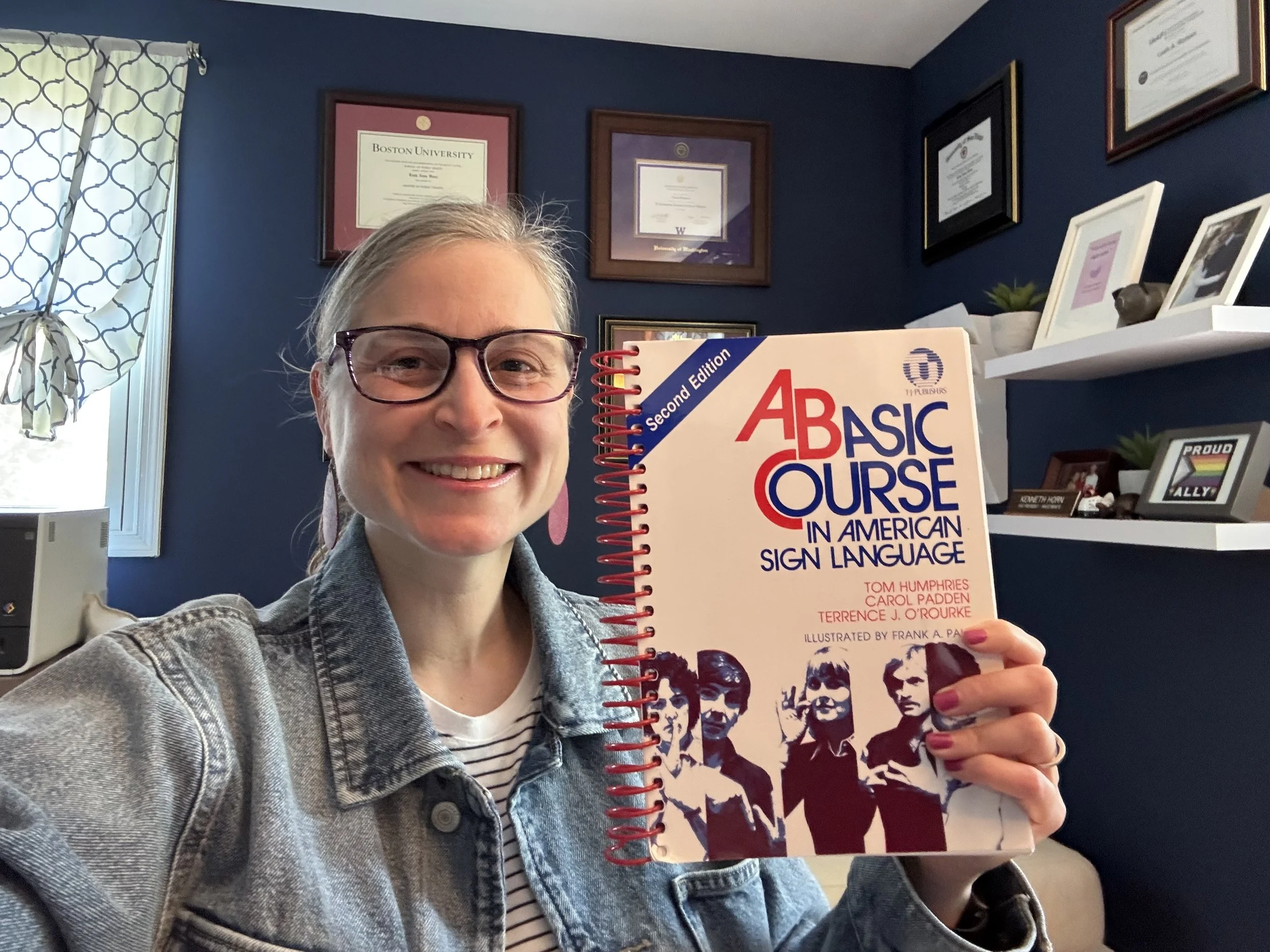
I’ve always been a student and professional who loves a good textbook. I love to read and take notes to learn. However, I’ve quickly discovered that two-dimensional learning does not work for me with ASL. While we do have a textbook, I find videos and in-class demonstrations are most helpful. I need to study the ASL user’s handshape, movement, and sign location, sometimes repeatedly, before I feel comfortable replicating the signs.
I’d love to hear from you!
Have you learned anything brand new lately? (professionally, personally, or for a hobby?)
If yes, what did it teach you about yourself and learning?
Post Author: Leah A. Roman, MPH, MCHES, CPACC
Last Page Edit: May 12, 2026